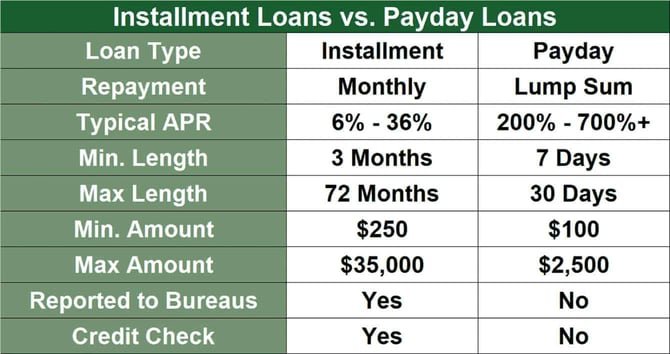
A lot of people think a low credit score is a dead end, a digital “no” that shuts the door on any kind of traditional lending. There’s this idea that if your FICO score is too low, you’re stuck with high-interest payday loans that just trap you in a cycle of debt. That’s a common misconception. A bruised credit history definitely makes things harder and limits your choices, but it doesn’t mean you can’t find capital through structured repayment options.
The reality is a bit more complicated. The lending market is essentially split into two worlds: the fast-moving, high-risk world of payday loans and the more predictable world of installment loans. Knowing which path you’re taking, and what it’s actually going to cost you, is the difference between fixing a temporary cash crunch and falling into a massive financial hole.
When an unexpected car repair pops up on a Tuesday and your paycheck isn’t due until Friday, the instinct is to grab whatever cash is fastest. But the terms of that money matter way more than how quickly it hits your bank account. People often treat these two products as if they’re the same thing, but they work very differently in terms of how you pay them back and how they affect your ability to borrow again later.
The Mechanics of Installment Loans for Bad Credit
Installment loans are the workhorses of personal finance. Unlike a credit card where you might just pay a minimum amount every month, an installment loan gives you a lump sum upfront. You pay it back in fixed, scheduled amounts over a set period, usually months or even years. That structure gives you an “end date,” which is much easier to manage than a revolving line of credit that never seems to go down.
If your credit isn’t great, these loans are going to be more expensive than they would be for someone with a 750 score. Lenders see a low score as a higher risk of you defaulting, so they hike the interest rates to offset that. However, LendingTree notes that it is possible to find rates below 36%, even when your credit history isn’t pristine. That 36% mark is important; it’s the line between a manageable loan and a predatory one.
If you’re looking for more stability, you have to shop around. Take Marcus, for example. He’s a freelance graphic designer who was hit with a sudden $1,200 medical bill. He found that checking multiple lenders was the only way to avoid the “quick cash” trap. He needed to spread that $1,200 over six months rather than trying to pay it all back in one crushing lump sum on his next payday.
Comparing Loan Structures
It helps to look at how these funds are actually handled. If you go with a loan that has a fixed term, you know exactly what your monthly budget needs to look like. There are no surprises.
- Fixed Terms: Most installment loans have a set maturity date.
- Predictable Payments: The amount you owe each month stays the same.
- Credit Impact: On-time payments can help rebuild your score over time.
The downside is the interest. You’re paying for the convenience of having the money now. If you take a twelve-month loan, you’ll end up paying back significantly more than the principal, but you won’t feel the sting all at once. This is why many people use PaydaySeek loans as a baseline for comparison when they’re evaluating their actual borrowing needs and interest costs.
The Payday Loan Trap and Its Real Costs
Payday loans are a different beast. They’re built for speed, often providing funds within a single day or even instantly. They’re essentially short-term bridges to get you from one paycheck to the next. Because they’re so fast, they usually require very little documentation or credit checks. That makes them accessible to almost anyone, which is exactly why they can be so dangerous.
The real danger is the “rollover.” Many payday loans are set to be due on your next payday. If you can’t pay the full amount back when the term ends, the lender might offer to “roll over” the loan into a new one. That sounds helpful, but it’s just a way to charge you more interest on the same debt you already owe. It’s a cycle that is incredibly hard to break without outside help.
According to research from CardRates, payday loans can lead to frequent rollovers, which significantly increases the total cost of the debt. Instead of a one-time fee, you end up paying a series of fees that can eventually exceed the original amount you borrowed. Understanding the distinction between an installment loan and a payday loan is the most important lesson a borrower can learn.
Identifying High-Risk Lenders
Not all lenders are the same. Some services act as middlemen, connecting you to various lenders rather than being the lender themselves. This can be helpful for finding a match, but it also means you might be looking at a lot of different offers at once.
- Lender-Connecting Services: These networks search for multiple lenders to see who is willing to take a chance on your credit.
- Hard vs. Soft Credit Pulls: A “soft” pull won’t hurt your score, but a “hard” pull, which happens when you officially apply, can cause a slight, temporary dip.
- Unsecured vs. Secured: Unsecured loans don’t require collateral like your car or house, making them easier to get but more expensive.
When you’re looking at options, always ask for the APR (Annual Percentage Rate). The interest rate might look low, but the APR includes all the fees and tells you the true cost of the money. It’s the only number that really matters when you’re comparing two different offers.
Finding Guaranteed Options in a Restricted Market
The term “guaranteed” is a big claim in finance. No legitimate lender can guarantee approval without looking at your ability to repay. However, online lending networks have changed things. They use algorithms to scan a wide array of lenders to find those whose criteria match your specific situation. This is particularly useful if traditional banks have turned you down in the past.
These networks are often the best bet for people who need a specific amount of money for a non-negotiable expense. While a traditional bank might see your debt-to-income ratio as a problem, an online network might find a lender that focuses more on your recent employment or steady income. It’s about finding the right “fit” rather than just finding “money.”
For those who want a more structured approach, Acorn Finance offers installment loans for bad credit that act more like personal loans. This provides a middle ground. You get the accessibility of an online lender but the repayment structure of a traditional bank. It’s a way to avoid the “emergency” feel of a payday loan while still acknowledging that your credit isn’t where you want it to be.
| Feature | Payday Loan | Installment Loan |
|---|---|---|
| Repayment Term | Days or weeks | Months or years |
| Payment Amount | Full principal + interest | Fixed monthly payments |
| Credit Impact | Minimal to none | Can help rebuild credit |
| Typical Use | Planned expenses |
Even with bad credit, the goal should be to move toward the installment side of things. An installment loan is a tool for managing life; a payday loan is often a tool for managing a crisis that was already building. One builds a foundation, while the other often digs a hole.
The Real Cost of Speed and the Path Forward
If you need to borrow, prioritize the type of loan that has an expiration date. Even if the interest rate is higher than what you’d get with perfect credit, the predictability of a monthly payment is worth it. You can plan your budget around it. You can see the finish line. That psychological certainty is just as important as the math.
Before you sign anything, read the fine print. Look for “prepayment penalties.” Some lenders will charge you a fee if you try to pay the loan off early. If you come into some extra cash and want to get out of debt faster, you shouldn’t be punished for being responsible. A good lender will let you close the account without an extra fee.
Borrowing money is a trade. You are trading a portion of your future income for immediate liquidity. If that trade helps you stay employed, keep your car running, or stay housed, it might be a necessary trade. But if that trade is simply to cover the interest on a previous loan, the math will never work. Stay focused on the principal, watch the APR, and always look for the end date.
You might be thinking, “But what if I can’t qualify for an installment loan at all? Isn’t a payday loan my only option?” There are almost always other options before you reach that point. From credit unions to specialized online networks, the goal is to find a lender that views your income as a sign of stability, not just your credit score as a sign of risk.